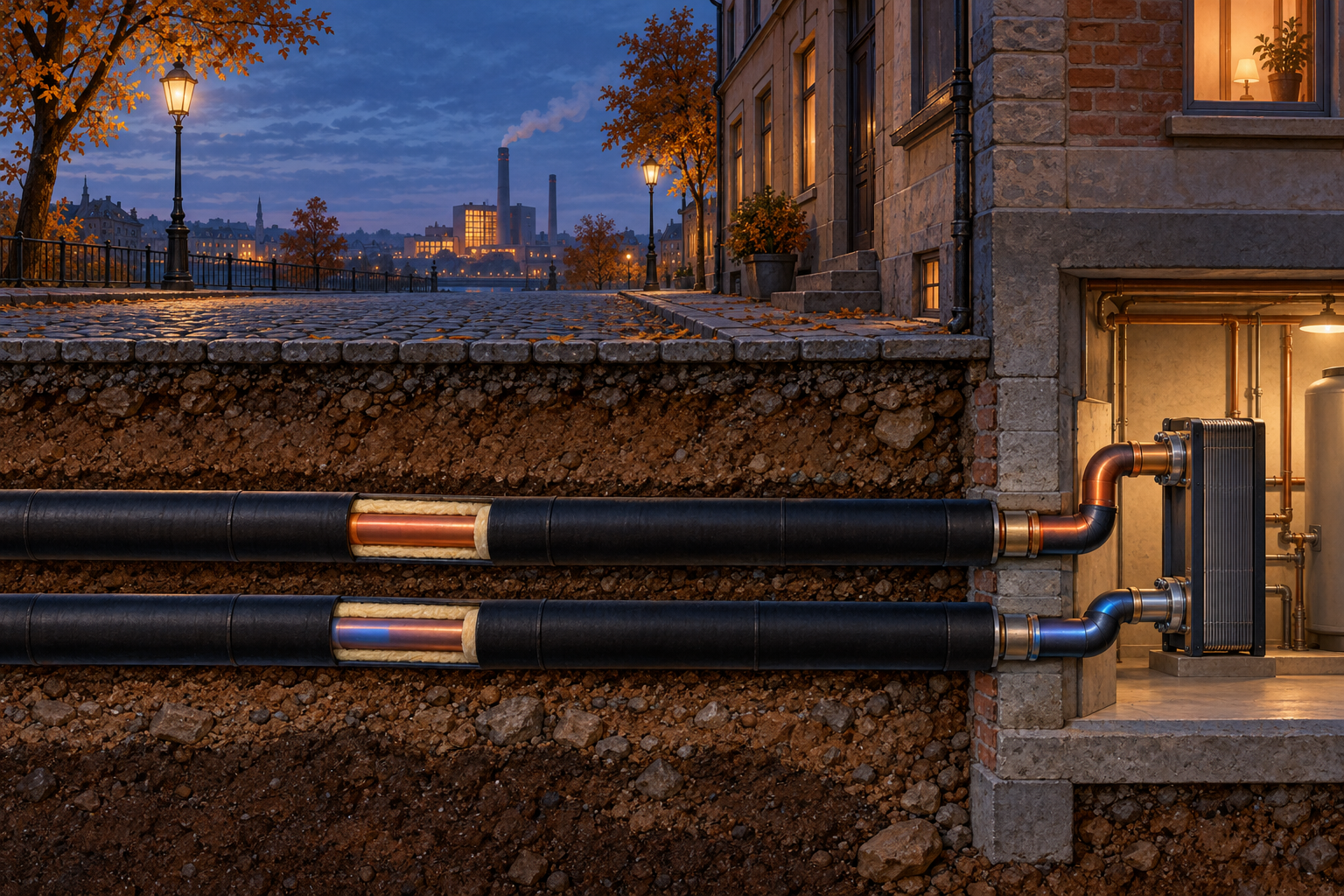
At 2:05 on successive July nights in 2017, a sensor in central Adelaide recorded a change in the sound of a buried water main. The utility team's account shows a quiet reading, then a stronger one as a crack developed in a 100-millimetre cast-iron pipe beneath Liverpool Street. An alert brought people to the site; a field team narrowed the location, and the pipe was repaired on the night of 24 July. No jet of water had to announce the trouble at the surface. The first visible sign for the utility was a change in a measurement.
That is how a city often finds a hidden leak: it moves from a suspicion about water or noise across a wide network to evidence about one section of pipe. An unexplained flow cannot identify a hole. A sound at one access point cannot always distinguish a leak from ordinary city activity. A sensor array can point toward a place without showing a crew what the pipe looks like there. Each stage reduces the search area and tests the previous stage's interpretation.
First, account for the water
A utility can compare the water entering its distribution system with the water customers use and the amounts authorized for other purposes. The difference deserves investigation, but it is not automatically leakage. The US Environmental Protection Agency's water-audit guide separates real losses—water leaving mains, service connections or storage facilities—from apparent losses caused by meter error, unauthorized consumption or data-handling mistakes. Unbilled authorized uses sit in the accounting too. If a supply meter reads high or customer meters read low, the arithmetic can make a sound pipe network look leakier than it is.
An annual audit is therefore a starting map of uncertainty, not a map of holes. The EPA's detailed loss-control manual warns that underestimating apparent losses overstates the inferred real loss. It recommends checking records and meters, then gathering more local information where the balance points to trouble. A sudden change in an account may be a leak, an unrecorded use or an open valve. For a city, checking the numbers before sending a crew to break pavement is part of leak detection.
To get closer, a utility can meter the water entering a defined district, with its boundary valves and other connections understood. The district is smaller than the whole city, so a change in inflow is easier to investigate. Canada's National Research Council describes district audits that compare flows at different times or with that district's earlier pattern, allowing for known around-the-clock uses. A high minimum flow while most customers are inactive can raise suspicion because a continuing leak does not go to bed. Still, someone may be using water at night, and pressure and meter accuracy affect what the trace means.
The NRC also describes a more deliberate narrowing method, step testing: utility staff isolate subdivisions in sequence and watch how the measured flow changes. A marked drop after one section is shut can place the excessive loss within that section. It cannot tell the repair crew which joint or length of pipe to uncover. The procedure depends on knowing the network, controlling valves safely and accounting for legitimate demand. It is a utility operation, not a household trick for finding a leak.
Even the quiet-hour assumption has a boundary. In a study of an intermittently supplied district in Zarqa, Jordan, researchers found that customer storage tanks kept filling after service resumed. The lowest flow could occur during the day as well as at night, depending on tank levels. For their tested district, they supplied water continuously for several days before using the flow pattern to estimate leakage. A rule that works tolerably in a continuously supplied residential district can give a false answer where supply is intermittent or normal demand follows another schedule.
Then, listen for the right sound
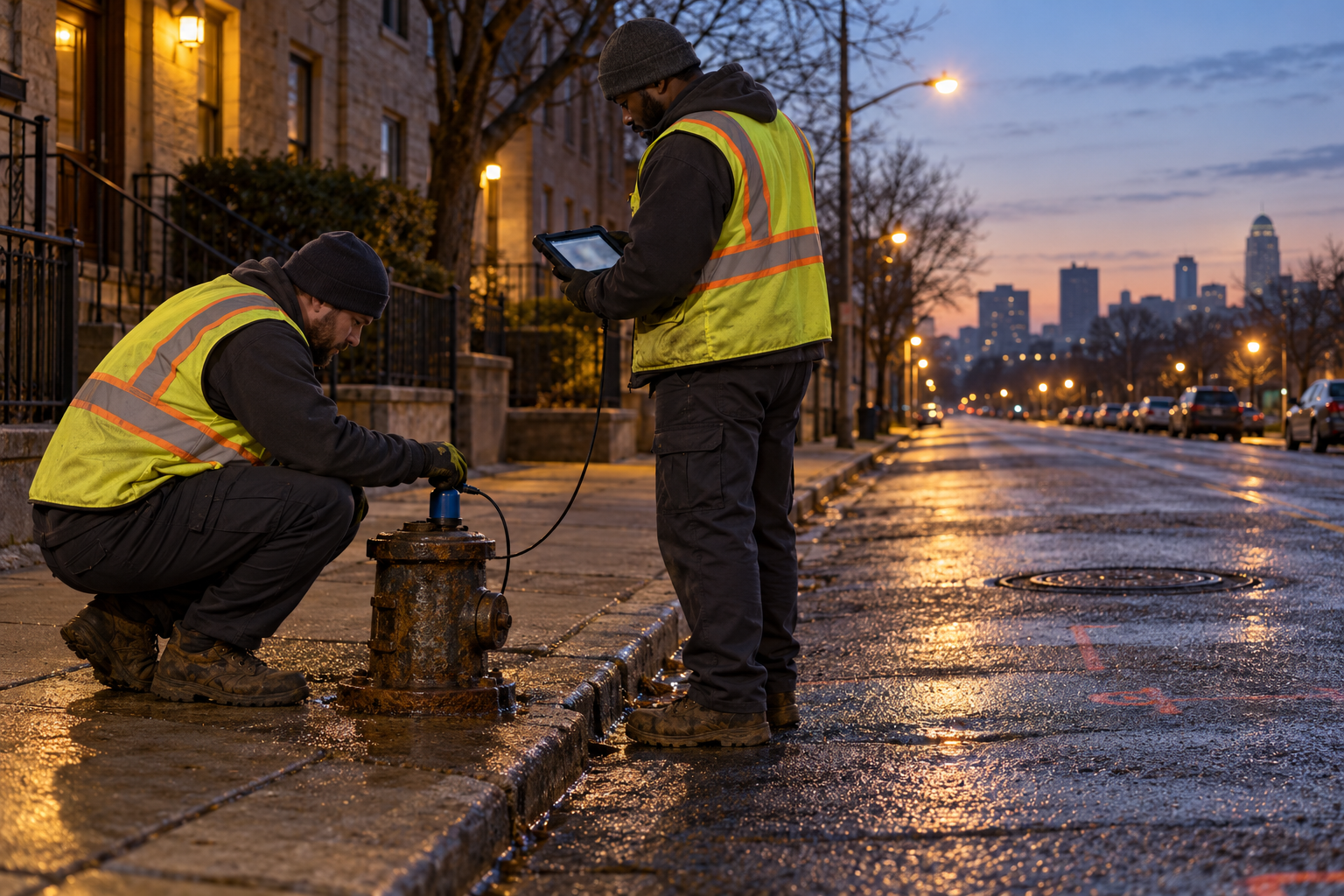
Once flow records identify a likely area, sound can help resolve the last few streets. Water escaping a pressurized pipe makes the pipe and surrounding ground vibrate. A crew can listen at hydrants or valves, where instruments touch the network, and then use a ground microphone above the suspected route. The NRC's account of field surveys distinguishes the wide-area audit from this point-by-point listening. The audible or measurable signal is a consequence of the escaping water; it is not the water itself reaching the surface.
Two sensors can do something a single listener cannot. Placed at accessible pipe points on either side of a suspected leak, they receive similar vibrations at slightly different times. A correlator compares those signals and estimates the time lag. With the distance between sensors and the speed at which vibration travels in that pipe, a trained operator can infer a location along the section. The EPA explains the timing method and notes that travel speed depends on pipe size and material. An inaccurate pipe map, an undocumented repair or an incorrect speed assumption can shift the calculated point. The result directs a field investigation; it does not warrant digging wherever a screen flashes.
Pipe material can decide whether a leak is easy to hear at all. In controlled tests of plastic water pipes, Osama Hunaidi and colleagues found that much of the leak signal lay below 50 hertz. The correlator settings used by professional crews often filtered out the relevant low frequencies, and simple listening devices worked poorly unless close to the leak. The researchers did locate leaks acoustically when methods were adapted. Their finding is a reason to adjust sensors and interpretation to the pipe, not a rule that plastic mains never make detectable noise or that every quiet reading proves a tight pipe.
Adelaide's system shows how those measurements fit into actual work. The utility and university team reported 305 acoustic accelerometers installed across the central business district. Software examined night noise and changes from learned patterns, but trained operators reviewed the alerts before a field crew went out with listening sticks, ground microphones or portable correlators. In the first six months after commissioning, the system detected 27 leaks; most were at or downstream of customer meters, hydrants or isolation valves, though the Liverpool Street pipe crack was among the main-pipe findings. The case does not show a sensor network replacing inspection. It shows a sensor network giving inspection a better place to start.
Noise needs context as much as flow does. Traffic, complex pipe connections and changes in pipe material can obscure or move a signal. The Adelaide team reported that field crews sometimes calibrated sound speed where the asset record did not capture a repair. They also tuned alert thresholds against months of ordinary noise to reduce false alarms; their original data-transfer arrangement meant the average gap from leak onset to an alert was 16.2 hours in that first period. An alert is a prompt for judgment, and the time it takes to arrive matters if the pipe is failing rapidly.
Other instruments can add evidence when the acoustic path is poor. A California Energy Commission field evaluation compared continuous acoustic monitoring and satellite imagery in utility networks and reported that both found subsurface leaks. Its authors recommended choosing technology according to the system, budget and field conditions. The promise of a remote image or a permanent sensor should not be confused with a universal, precise underground map. A signal still has to be tied to the correct pipe and checked on site.
The final test is what happens after action. The EPA's loss-control sequence ends with evaluation: repair a confirmed physical loss, then see whether the water balance and local indicators improve. A lower district flow or a changed acoustic trace can support the conclusion that the work addressed the leak; another unexplained loss may remain nearby. In Adelaide, one reported customer-side leak showed a sharp fall in recorded noise after the customer acted, a useful check on the original interpretation. On Liverpool Street, crews ultimately found the developing circumferential crack. The city's instruments had shortened the search, but the exposed pipe supplied the answer they could not give alone.
A hidden leak is rarely found by one clever device. It is found by asking progressively smaller questions of a buried system: Is water truly being lost? Which district changed? Which pipe section carries the signal? Does inspection reveal the damage, and does repair change the measurements? The method has room for meters, maps, listening, models and sometimes remote sensing. Its discipline lies in knowing what each reading can say, then making the next observation close enough to settle what it cannot.
A thought worth keeping?