A new asphalt patch is usually judged by its surface. Is it level with the road? Are its edges tidy? Those details matter, but they conceal the decision that gave the patch its shape and depth. Before filling a failed section, a repair crew has to ask what, exactly, failed. The answer may be the asphalt itself. It may be the stone beneath it, the soil beneath that, or the route by which water reaches either one.
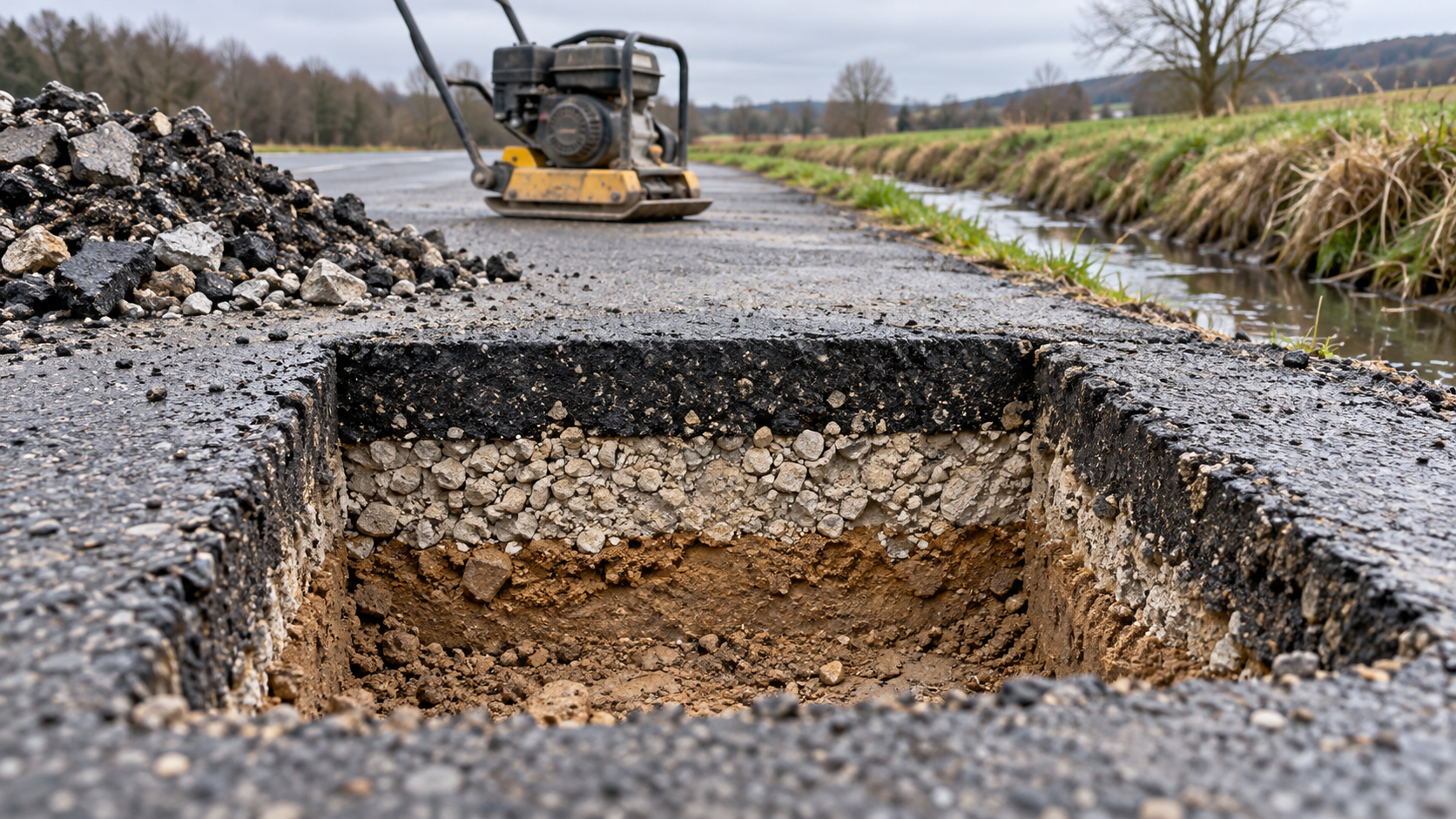
This is why a pavement repair starts below the surface, even when the eventual treatment is shallow. The first task is to understand what the road is resting on. Asphalt roads are layered structures: a bound surface carries traffic and resists wear; a base and sometimes a subbase spread load and help manage water; the subgrade is the prepared native soil below. The Federal Highway Administration's geotechnical manual treats these as one working system. A strong-looking skin cannot make every weak foundation disappear, but cutting out sound foundation material wastes effort and can disturb the support a patch needs.
Read the mark, then test the cause
The surface gives clues, not a complete diagnosis. A cluster of small, connected cracks in a wheel path points toward fatigue under repeated loads; the FHWA distress identification manual records whether the pieces are merely outlined or have begun to move and pump material under traffic. A pothole is the later, more visible loss of material. A smooth depression or a pair of wheel-track ruts tells a different story, and the depth of that story is not obvious from a passing car.
California's guidance on localized asphalt distress makes an especially useful distinction. A rut can form because an unstable asphalt mixture shifts within the surface course; it can also reflect movement in lower layers or the subgrade. A crescent-shaped slippage crack may instead show that two asphalt layers have lost their bond. Digging to soil for every rut would confuse these mechanisms. Laying a thin new surface over a failed base would confuse them in the opposite direction. The visible pattern guides the investigation; it does not replace it.
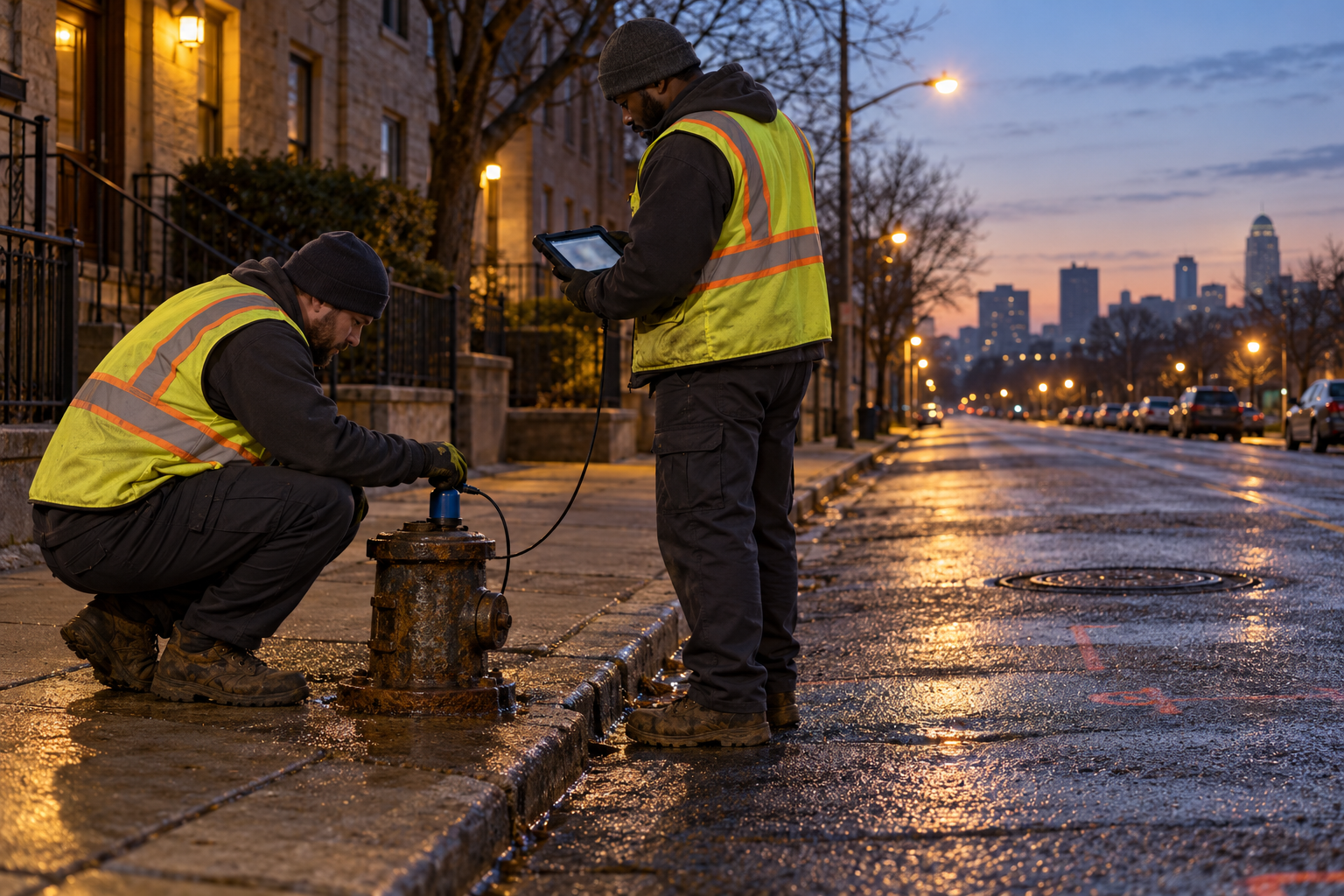
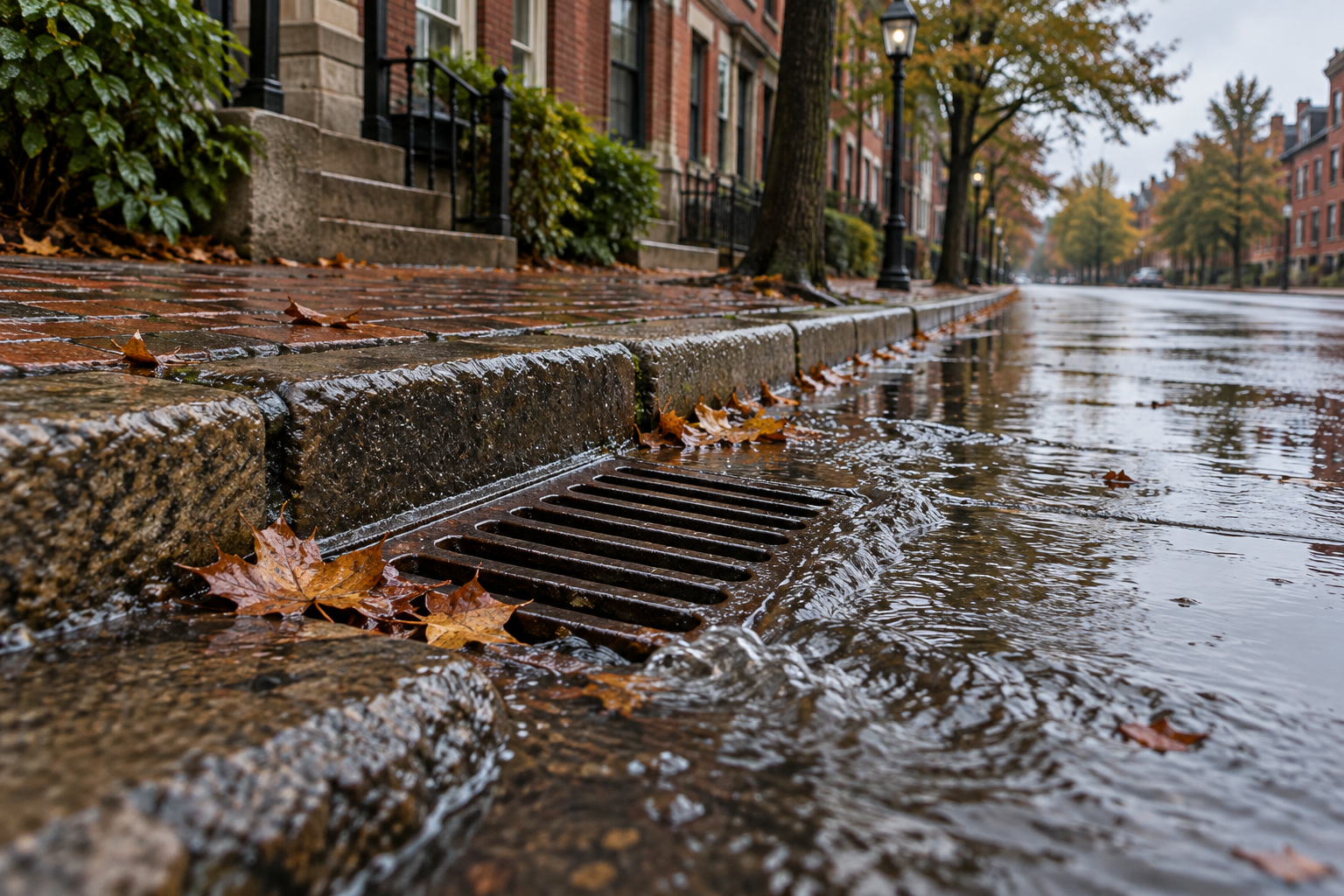
Water often complicates that investigation. Rain can enter through an open crack, but it can also reach the road from its shoulder or rise from groundwater. The FHWA geotechnical manual describes how excess moisture can weaken unbound base and subgrade materials, move fine particles, and leave the pavement less able to bear repeated wheel loads. In colder places, freezing and thawing add another disturbance. No single pothole proves that water was the original cause. Yet a repair that finds wet, soft material must ask where the water came from and where it can go, or the new asphalt may cover the same weakness.
For a planned repair, the crew can examine the pattern around the damaged spot, the road's history, and the shoulder or ditch beside it. Larger rehabilitation projects may use cores, subsurface samples, or deflection testing to learn how the layers respond under load; these are among the methods described by FHWA for existing pavements. At the scale of a local patch, the decisive evidence may appear when the asphalt is lifted. Is the aggregate base still firm and well supported? Has fine soil migrated upward among the stones? Does a probe enter material that ought to resist it? Caltrans's local-repair guide calls for examining and probing the exposed base as material is removed, then extending a dig-out until firm support is reached where the base has failed. Its numerical probe criteria belong to that agency's procedure; the general lesson is to set the repair depth from the condition actually found.
Rebuild only what failed
If the trouble is confined to the asphalt surface and the underlying base is sound, the base can stay. Caltrans's guide explicitly calls for preserving it during a partial-depth repair. This is a meaningful choice, not a corner cut: the intact base is already doing its job. California's flexible-pavement maintenance manual likewise tells crews to determine whether base failure caused the damage before repairing the surface, and says that even when base failure is evident, a surface repair may sometimes add enough strength that replacing the base is unnecessary. The right depth depends on the pavement structure, distress, and intended service, not on a rule that every crack demands excavation.
Where the base has lost support, the work is more exacting. The repair must reach sound material and extend into sound pavement around the failed area. Caltrans's dig-out procedure calls for neat saw-cut limits, removal of loose material, inspection of the base left behind, and compacted replacement layers when the excavation is deep enough to require them. The cut sides matter because fresh material needs firm neighboring pavement to press against. The bottom matters because a roller or plate compactor cannot turn soft ground into a reliable foundation by flattening the asphalt above it. The replacement layers need their own compaction; a smooth top alone cannot tell you whether that happened.
Drainage belongs in that reconstruction when moisture helped cause the failure. An outlet may be blocked, a shoulder may feed water into the roadbed, or a crack may have let surface water enter. The FHWA manual frames the choices as limiting entry, using materials less sensitive to water, and removing water that does enter. Caltrans's distress guide says drainage should be corrected first when water is a factor in cracking or settlement. That does not mean every patch needs a new drain. It means a crew should not treat wet support as an isolated hole if a continuing flow is feeding it.
The new asphalt has to work with what remains. A clean, sound patch boundary gives the compacted mix support at its sides; a suitable bond at the interface helps keep layers from sliding apart. Caltrans's guide describes priming the cut sections and compacting asphalt flush with surrounding pavement. The earlier slippage-crack example shows why the bond matters. These visible finishing steps are the last part of a sequence that began with diagnosis, not a substitute for it.
There are times when the road must be made safe before a full investigation and reconstruction can be arranged. A deep or dangerous pothole cannot wait for ideal weather or an empty traffic lane. The FHWA pothole-repair manual, based on field studies, describes a rapid “throw-and-roll” patch in which placed material is compacted by truck tires. It also describes a more laborious method that clears water and debris, squares the sides to sound pavement, then places and compacts the mix. The faster repair is a practical response to traffic and safety; its expected life depends on material and conditions. Calling every quick patch careless ignores that constraint. Calling it a cure for a wet, moving foundation ignores the next winter or heavy wheel.
Early work can keep that choice from becoming necessary. The Minnesota asphalt-maintenance handbook treats crack sealing and other surface treatments as ways to slow deterioration while the pavement is still structurally sound. When distress reflects a structural deficiency, it says the road is generally a candidate for rehabilitation or reconstruction instead of ordinary preventive maintenance. The distinction brings the repair back to its starting question. A patch should be no deeper than the failure requires and deep enough to remove the failure it is meant to fix. The dark rectangle visible afterward is only the final layer of that judgment.
A thought worth keeping?