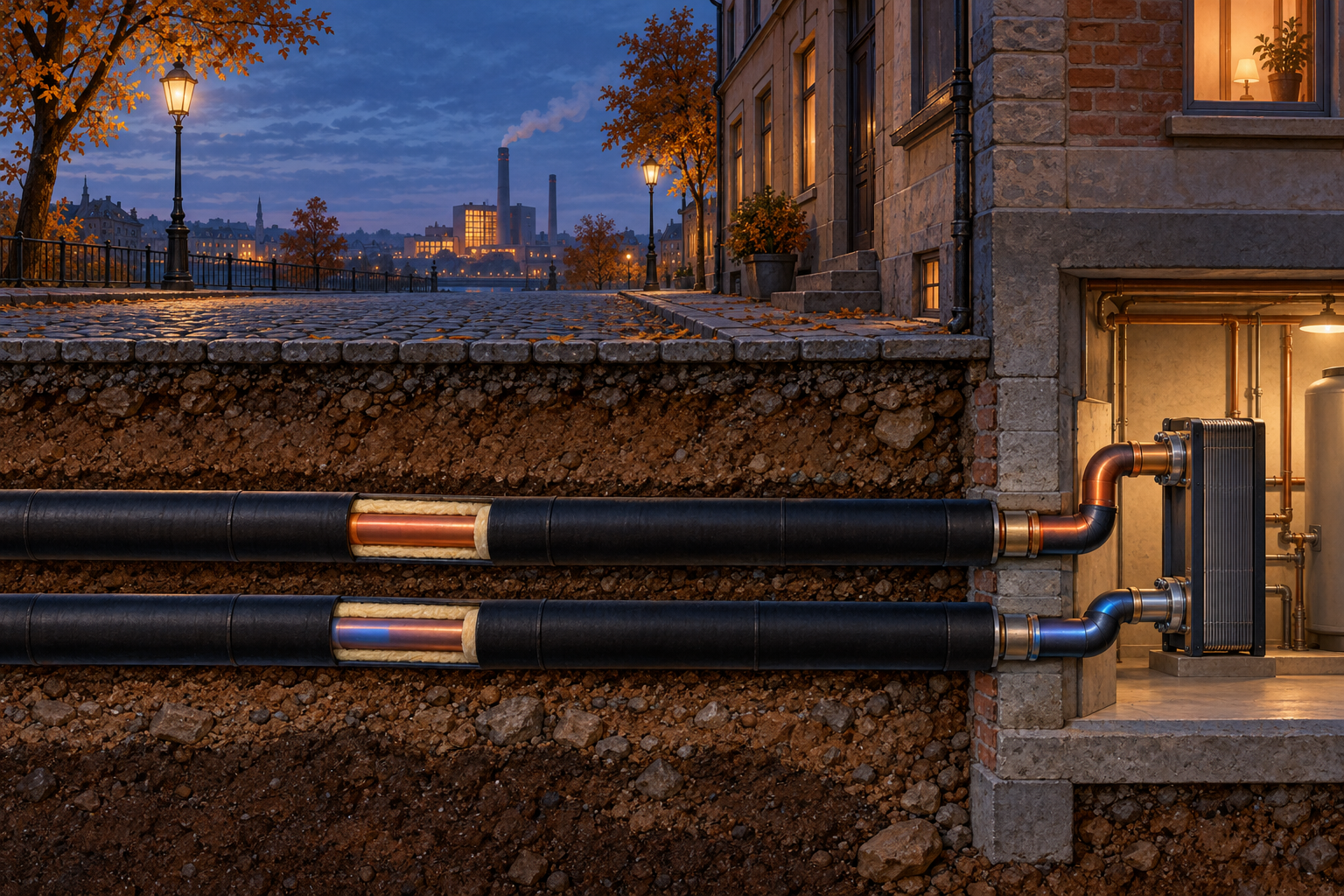
Under a street served by district heating, two pipes have different jobs. One takes warmed water toward buildings. The other brings it back after the buildings have taken some of its heat. The plant heats the returning water again, and the circuit continues. A pipe that merely stays hot has not necessarily done its job: the question is how much useful heat reaches the connection and leaves the water there.
The supply-and-return loop is the basic arrangement of a hot-water district network. At an indirectly connected building, district water passes through a heat exchanger; the building's own heating water passes on the other side of a metal wall, receiving heat without mixing with the network water. Direct connections also exist, so the exchanger is a common example rather than a rule for every address. The European Commission's district-heating report describes both the pre-insulated pipe network and the role of exchangers. An original network-model study represents the outward and return paths as a circuit joined at customers and the heat source.
Keeping heat in the right place
The water in a buried supply main is warmer than the surrounding earth. Heat therefore crosses the pipe wall and insulation on its way to the soil. The return main may lose heat too, though its temperature is usually lower. A typical rigid pre-insulated assembly places a steel carrier pipe inside a protective outer casing, with polyurethane foam in between. That construction is a barrier, not a thermos that can hold a temperature unchanged along a route. Lidén and Adl-Zarrabi's field study describes such a pipe and investigates its thermal condition in service.
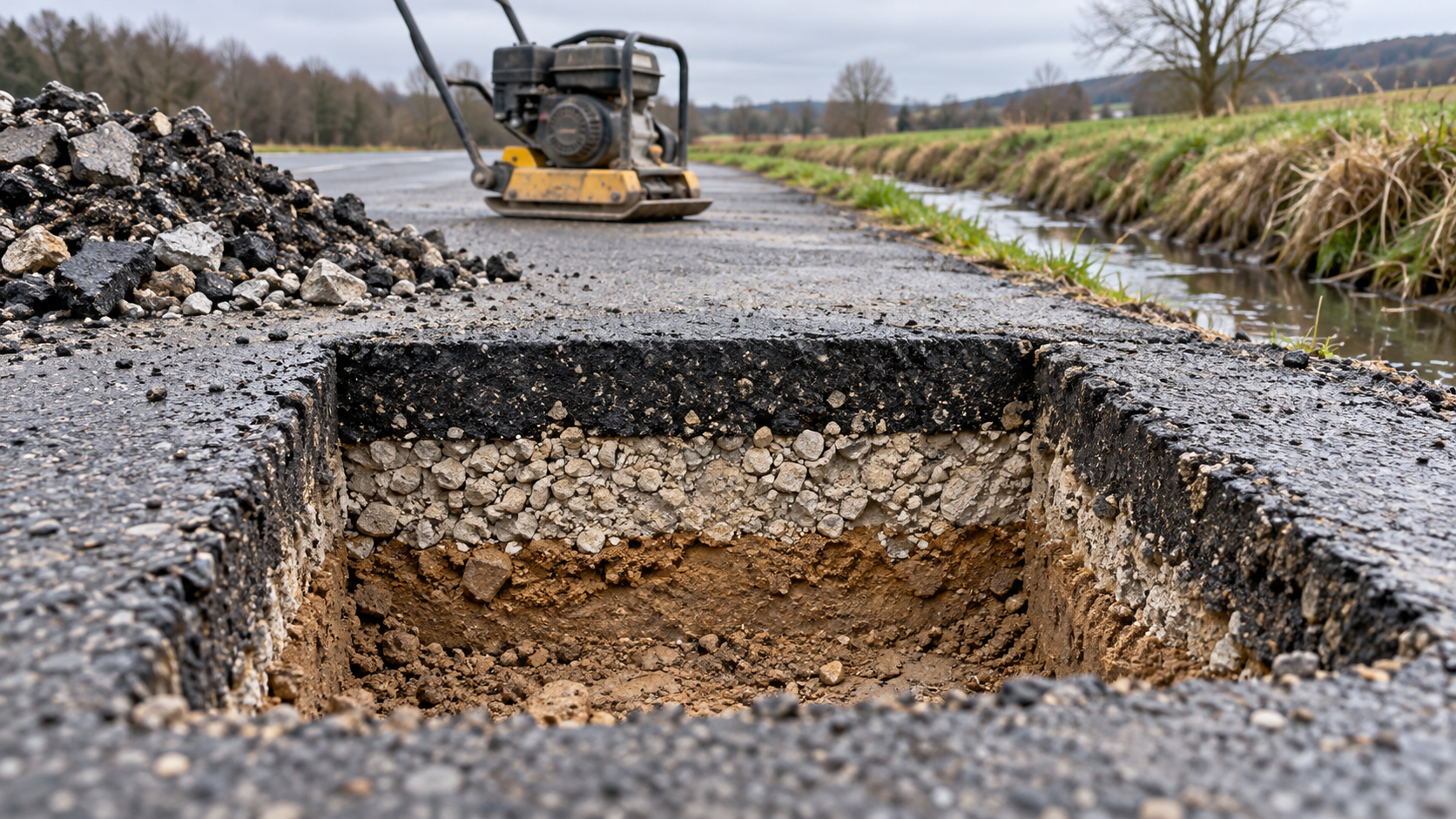
How much escapes depends on the temperature difference, the pipe's dimensions, the insulation and the surroundings. More insulation generally raises resistance to heat flow; damp or aged materials can behave differently from their catalogue values. The earth has a temperature and moisture history of its own. Using a winter air temperature as though it were the temperature touching every buried pipe would hide that difference. ASHRAE's district-heating design chapter treats the thermal properties of both insulation and soil as design variables. Deming Wang's 2022 heat-transfer study likewise shows how length, insulation and thermal conductivity affect modeled loss. Its particular percentages are results under specified assumptions, not a single efficiency figure for all networks.
The return line makes the stakes clearer. A building could receive quite hot water but send it back almost as hot because too little heat was transferred. A lower return temperature, within what the equipment and service need permit, means the same stream of water has given up more heat at the building. A heat meter consequently uses flow and the temperature difference between inlet and outlet to calculate heat delivered over time. Temperature alone is not delivered energy; the volume that passes and the fall in temperature matter together. The European Commission report describes those measurements and explains why return temperature affects pumping and network losses. The useful difference is made at the customer, while both pipes must be insulated on the way to and from that point.
Keeping the circuit moving and contained
Hot water does not carry itself through a long, branched system. As it moves, friction in the pipe and fittings consumes pressure. Pumps provide the pressure needed for circulation, and the network must stay within the design limits of pipes, valves and exchangers. A larger flow is not a free way to compensate for poor heat transfer: it changes pumping demand and pressure drop. ASHRAE's hydraulic guidance explicitly joins the requirements for temperature, pressure and energy at the consumer. The 2023 network-model study treats mass balance, pipe friction and heat transport as linked parts of the same circuit.
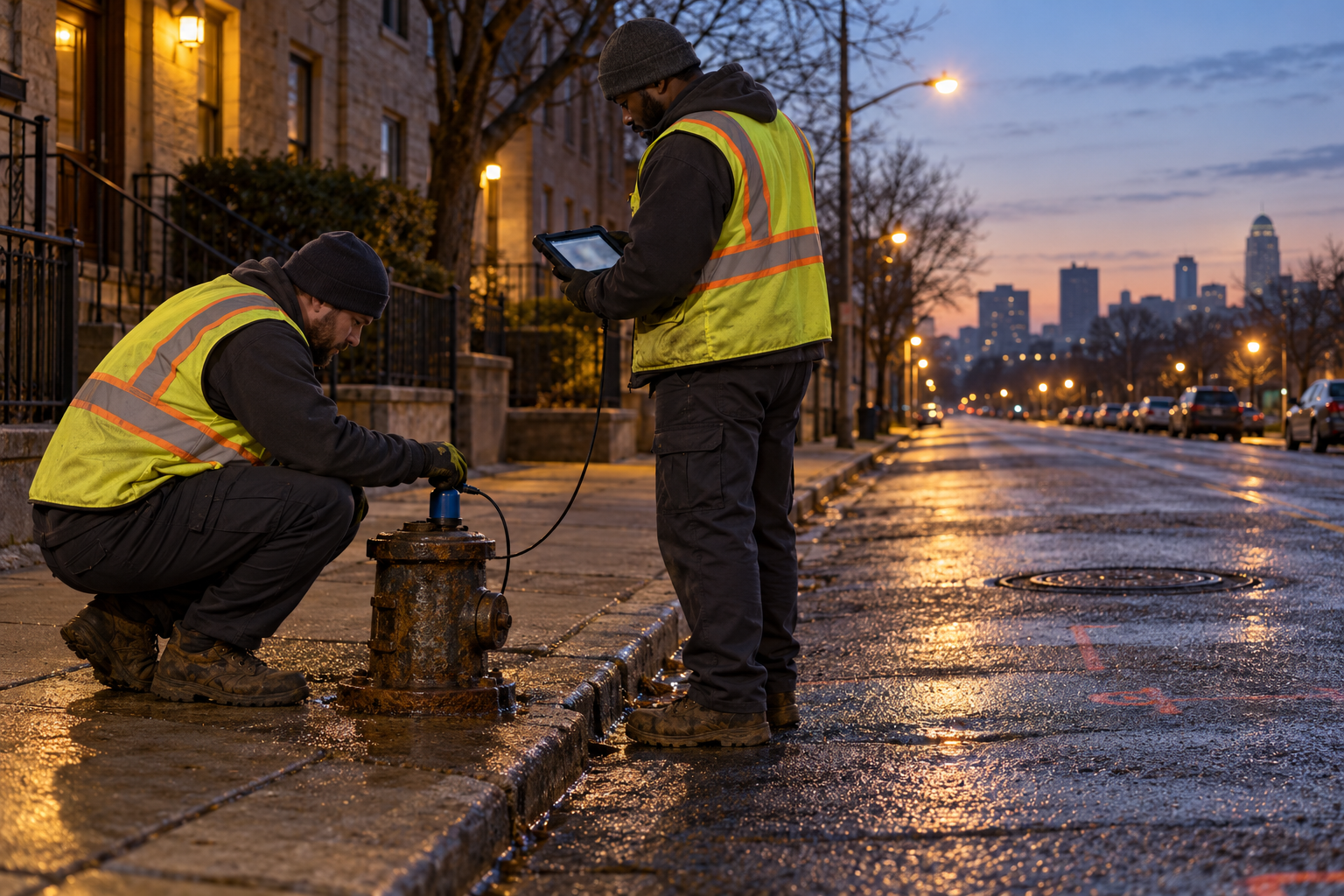
Keeping pressure also means keeping the water inside. A leak removes treated circulating water and can interrupt service; water reaching the insulation through a failed jacket or joint is another problem even before the carrier pipe leaks. The location can be hard to find under paving and soil. Some pre-insulated pipes include conductive wires embedded in the foam. A change in electrical response can indicate moisture within that layer, giving an operator a reason to investigate, rather than a complete diagnosis of its source. ASHRAE's leak-detection guidance also describes pressure testing and other locating methods. The Lidén field experiment used a wire normally associated with moisture detection in a new way: its temperature-sensitive resistance helped assess the insulation's thermal condition during a controlled cooling test. That is a research method, not a sensor every network already uses for heat loss.
Other approaches remain experimental. A 2025 laboratory study by Zhao and colleagues tested whether ground-surface temperature measurements could signal a leak in a sandbox model of an underground heating pipe. It demonstrates a possible route to non-invasive monitoring, but a controlled test bed cannot settle how accurately the method will work along every street, under changing soil, weather and traffic. In practice, pressure, flow, temperatures, moisture alarms and inspection each answer a different part of the maintenance question. A strange reading is a lead to follow, not a verdict on one buried joint.
Keeping room for movement
The steel pipe also changes length as its temperature changes. Installation, start-up and seasonal operation can put a pipe through different thermal states. If the route allows no way to absorb the movement or resulting stress, a connection or fitting may be asked to carry more than it should. The answer depends on the pipe system and its setting: a planned change of direction can provide flexibility, while other routes use loops, anchors or suitable expansion devices. ASHRAE's design chapter treats the required provision as a calculation tied to temperature, geometry and field conditions, not as one detail to copy from another street. The outside casing and the soil around a buried main complicate that calculation further.
This movement is why maintenance is not limited to looking for escaping water. Operators have to know where valves can isolate a section, how a particular pipe was laid, whether its insulation still performs, and whether a change in temperature or pressure is ordinary operation or evidence of deterioration. In a field test, Lidén and Adl-Zarrabi briefly isolated a selected line and watched its cooling to estimate thermal conductivity. That method shows the value of asking a narrow, answerable question about a real pipe instead of assigning an entire network the performance of a new product sample.
The paired pipes under the street carry a condition, not simply a substance. The outward pipe must bring enough heat and pressure to the connection; the return pipe must carry the water back after heat has been taken from it. Insulation slows an unavoidable escape to the ground. A sealed wall keeps the circuit whole. Room for expansion lets that wall survive changes in temperature. Measurements tell an operator when one of those promises may be failing. The heat that matters is the heat transferred before the water comes home.
A thought worth keeping?