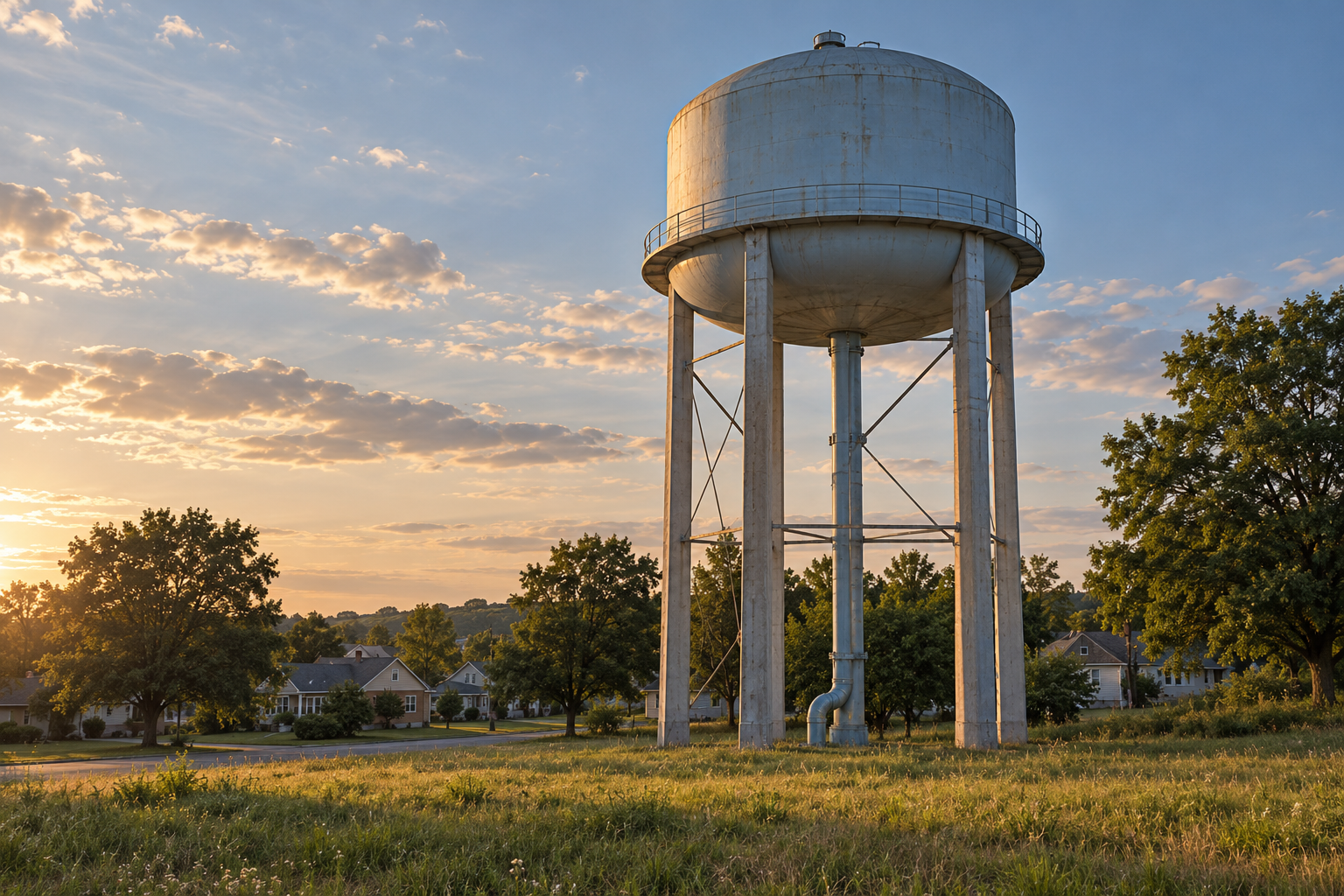
A water tower lets a town do some of its pumping before the water is needed. Pumps raise treated water into the tank. Later, as demand pulls the water level down, gravity helps move it through the pipes. The tank holds water, but it also holds a little room in the day's schedule: the busiest hour need not be met entirely by pumps running at that hour.
That room has limits. A tower cannot keep serving an area merely because water remains inside it. The remaining water must be high enough to provide useful pressure where people need it. And water held too long can become a water quality problem. The familiar silhouette above the roofs is part of a careful negotiation between height, volume, demand and time.
Why lift the water first?
Pressure in a gravity-fed system depends on the elevation of the water surface relative to the point of use, with losses along the route through pipes. A tank on a hill can serve the same general purpose as a tank raised on legs: both put water above the area they supply. The tower is one way to buy elevation when the ground does not provide enough of it.
The EPA's guide to small community distribution systems separates several jobs that storage can perform. It can help cover peak demand, maintain pressure, and provide reserves for emergencies or firefighting. Equalizing storage lets a supply system produce water at a steadier rate even when customers use it unevenly. Without that buffer, pumps and pipes might need to be sized for short periods of unusually high flow.
Picture a hypothetical service area whose demand climbs in the evening. Earlier, the supply has filled an elevated tank. During the busy interval, the tank can send water into the distribution system as well. Afterward it can refill. This is a description of a possible operating cycle, not a claim that every town fills and drains its tanks on the same clock. Some tanks exchange water through one pipe; others have different inlet and outlet arrangements. The actual flow depends on the system's hydraulics and controls.
The water surface is the important height, not the tower's roof. As the level drops, so does the available pressure. An EPA issue paper on finished-water storage notes that, in a standpipe, only the portion able to deliver water at the required pressure counts as useful storage for pressure equalization. The lower water may still have a role in an emergency, depending on the rest of the system, but its mere presence is not proof that every tap can be served.
That distinction makes a tower more interesting than a container measured by its maximum volume. Operators need to know the water level at which pressure becomes inadequate, including at the far or high parts of the service area. The shape of the tank, the site's elevation and the route through the pipes matter together.
What the reserve can cover
Elevated storage can buy time when a pump is out of service. EPA guidance on distribution pressure explains that stored water may temporarily maintain required system pressure during such an interruption. The word temporarily carries the engineering truth: the available time depends on the starting level, demand, usable volume and network conditions. A tower is a reserve whose duration has to be calculated for a particular place.
The reserve also has competing claims. A utility may want daily drawdown to help meet demand peaks, a margin for a pump failure, and enough water for the fire flows its system is designed to provide. Those purposes do not necessarily use separate, conveniently labeled layers of water. A decision to draw the tank farther down today changes what remains if an unusual demand arrives next.
This is why “keep it full” can sound prudent. But a full tank that rarely turns over creates another clock. Water entering today may not replace the water already sitting in a poorly mixed part of the vessel. The National Drinking Water Advisory Council working group's 2023 report describes how temperature differences, inlet and outlet flows, and tank geometry affect mixing. Its discussion treats reserve capacity for peak use, fire and emergencies alongside the risk of stagnant water. The report is advisory; its account of the trade-off is not a universal recipe for how full to keep a tank.
The age of stored water
Water age is the time water spends in the distribution system before use. EPA's water-age fact sheet explains why excessive age matters: disinfectant residual can be consumed, disinfection byproducts can form, and microbial growth can become more likely. These are possible consequences under particular water chemistry and operating conditions, not a diagnosis of a particular tower from its appearance.
A level gauge alone cannot tell the whole water-quality story. The tank might rise and fall each day while some water circulates poorly. In its guidance for consecutive water systems, EPA cautions that an average residence-time calculation may miss much older water in poorly mixed regions. Increasing drawdown can improve turnover, but pressure requirements can limit how far a tank can safely drain. Adjusting a pump schedule or valve therefore changes more than one variable.
The issue paper's account of a New Jersey standpipe trial makes that last point concrete. In a winter test, the reported turnover time fell from 8.3 to 4.6 days and chlorine residual rose only from 0.1 to 0.2 milligrams per litre. Longer pumping periods also overheated a booster pump motor and caused a failure. The reported result belongs to that system and season. It shows why an apparent improvement in turnover should be checked against water quality and equipment behavior, rather than treated as a self-explanatory success.
How would an operator learn what is happening in a different tank? EPA's 2019 tank assessment protocol pairs records of tank level with continuous measurements of chlorine residual to examine turnover and possible mixing problems. It also states a boundary of its spreadsheet estimate: the turnover calculation does not apply to tanks with simultaneous inflow and outflow. Useful monitoring begins by matching a method to the tank's actual operating pattern.
The tower above the roofs is easiest to see when the sky is clear and nothing seems to be happening. Inside, a changing water line records a series of choices: when to pump, how much pressure to preserve, how much reserve to hold, and how long treated water may wait. The tank's value lies in making those choices possible. Keeping it useful takes measurements and maintenance after the concrete and steel are finished.
A thought worth keeping?